Showing posts with label Bela Lugosi. Show all posts

Friday, October 9, 2015

Son of Frankenstein (1939)

For this year's Countdown to Halloween, it's all-Universal Monsters, all-the-time, from Dracula (1931) to The Creature Walks Among Us (1956).  Join me daily for a fresh perspective on movies you may not have watched in a long time, if ever.  Today, a sequel that I had forgotten was one of my favorites... Son of Frankenstein!


Little did I know when I re-watched Son of Frankenstein (1939) how much I would enjoy it.  My memory would have told you that the Frankenstein sequels got worse with each subsequent edition; however, I believe this one is every bit as good as Bride of Frankenstein (1935), albeit in a different way.

Primarily, it’s the style of Son of Frankenstein that I find unique.  Its sets are somewhat abstract, sparsely decorated with high ceilings, open spaces, sharp angles and shadows.  It’s Universal Monsters via The Cabinet of Dr. Caligari.  Art Direction is by eight-time Oscar nominee Jack Otterson and Set Decoration is by seven-time nominee/two-time winner Russell A. Gausman, both early in their careers.

I had also forgotten how many iconic moments come from this third chapter in the Universal Frankenstein series.  Son of Frankenstein has the first appearance of a character named, “Ygor” (Bela Lugosi).  It has the first time an angry mob accuses a villain of crimes before he has committed them.  And it has the one-armed inspector so hilariously made fun of in Young Frankenstein.


The screenplay by Willis Cooper also has the best character development of a Frankenstein so far in the Countdown.  Baron Wolf von Frankenstein (Basil Rathbone) starts out as a humble family man with no intention of continuing his father’s experiments, but is soon enamored by the “miracle” that came to pass in his laboratory, “a miracle that the people called a monster.”

The story is multi-layered, with all pieces cleverly fitting together.  Considered a dead man even though he survived a hanging, Ygor is not a hunchback, but does live with a healed broken neck.  He’s out to exact revenge on the jury that sentenced him and is using The Monster to do it.  It is also a survivor, having lived through the explosion at the end of Bride of Frankenstein that “blew the top off” his laboratory.

However, at the beginning of the movie, The Monster lies in a coma, giving Frankenstein a reason to crack his father’s notebooks and begin some experiments of his own.  We learn more about The Monster than we ever have before: he has three times the blood pressure of a normal man.  “He’s completely superhuman,” with two bullets in his heart, yet he continues to live.


We also learn a little mythology.  Apparently, not only did the original Frankenstein attract electricity by hanging his creatures in the sky, but also “cosmic rays” that help make The Monster superhuman.  This discovery leads to the gist of the movie spoken by Frankenstein, “I as a man should destroy him.  As a scientist, I should do everything in my power to bring him back to life so he can be studied.  That would immortalize his name.”

Speaking of his name, I had forgotten that the confusion regarding the identity of the name “Frankenstein” was something that began as early as the first movies.  You know, the fact that people call The Monster “Frankenstein,” when it’s really the man.  At the beginning of the movie, his son laments that history made his father suffer for his mistake.  “Today, nine out of ten people call that creature… Frankenstein.”  Meta, in 1939!

Inspector Krogh (Lionel Atwill) lost his arm to The Monster during an attack when he was a child.  It’s replaced with a wooden replica that he must use his other arm to manipulate, often with a sudden push or pull, but is very convenient for holding darts.  You know it’s inevitable, so this isn’t a spoiler, but you almost can’t wait for him to encounter The Monster as an adult so that it can rip off his arm again.


Son of Frankenstein feels modern in many ways, particularly the way it introduces a theme early on that you know will have importance later.  Here, its fear.  Frankenstein taught his son, Peter (Donnie Dunagan) never to be afraid.  That’s convenient when a “giant” soon begins visiting him through a secret passage in the nursery of the castle in which his family just moved.

It’s refreshing to not have a screaming child when confronted with danger.  Because he’s not afraid, he’s silent when The Monster learns that Frankenstein has betrayed it and kidnaps Peter, dangling him over a pit of hot sulfur.  Earlier, Peter is kind of annoying with his standard greeting, “Well hellooo,” but he soon becomes a somewhat endearing reflection of a childhood his father never had.


There is so much I like about Son of Frankenstein!  On top of everything I’ve described, and other delights I encourage you to discover, it has a phrase that’s so obvious and funny that it becomes sublime.  As the finale begins, Inspector Krogh declares, “There’s a monster afoot.”  Yes there is.  But there’s also one of the most overall entertaining Frankenstein movies afoot.  It’s one of my favorites.

Tomorrow: The Invisible Man Returns!

Thursday, October 1, 2015

Dracula (1931)

For this year's Countdown to Halloween, it's all-Universal Monsters, all-the-time, from Dracula (1931) to The Creature Walks Among Us (1956).  Join me daily for a fresh perspective on movies you may not have watched in a long time, if ever.  Today, the one that started it all... Dracula!


With so many screen versions of Dracula produced during the last 84 years, it’s sometimes easy to overlook Universal’s 1931 original.  Everyone has a favorite Dracula, whether it is Christopher Lee, Frank Langella, Jack Palance, or one of a host of others.  However, every so often we should pay tribute to the original, Bela Lugosi.  I daresay without his performance in the title role, few others would have followed.

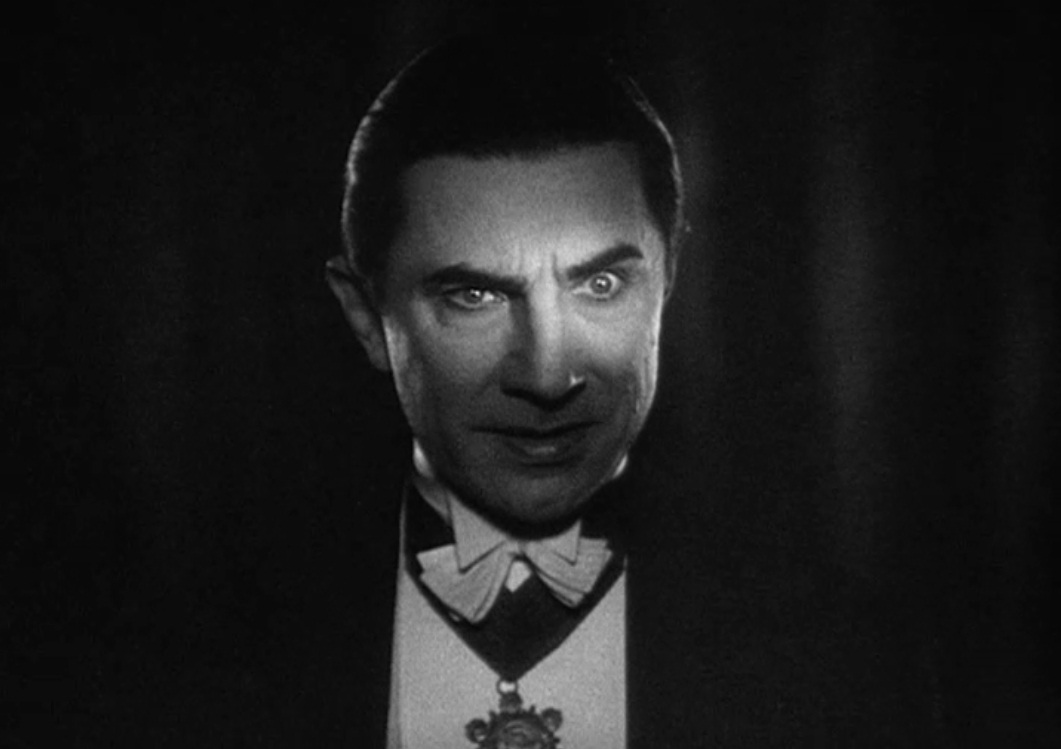
We see Lugosi first rise from his coffin five minutes into the movie.  Age has been kind to the atmosphere of Dracula.  Any loss of film quality only adds to the foggy, dreamlike quality of the scene.  As his bony fingers slowly emerge from the coffin, various rats and insects likewise crawl in and out of other confined areas of the castle’s vast basement chamber.  While we witness one of his three “brides” actually sit up in her coffin, we only see Dracula standing by his while the camera moves closer to his mesmerizing eyes.


His reputation precedes him.  En route to the castle, Renfield (Dwight Frye) hears from the Transylvanian townspeople rumors that Dracula and his wives take the form of wolves and bats and leave their coffins at night.  The stories don’t deter him, though; he’s there to deliver a lease on Carfax Abbey.  After a mysterious, driverless carriage ride to the castle, Renfield enters a cavernous foyer where his host slowly descends from the stairs and bids him welcome.

Renfield’s time at Castle Dracula is not long, though, and ends with a visit from a bat and the three zombie-like brides.  We next see him “aboard the Vesta,” a ship “bound for England.”  He’s now become a raving madman, opening Dracula’s coffin and telling his master when the sun has gone down.  This scene, familiar in many other versions of the story, unfolds here with little mystery, even though the ship arrives in London and is found with everyone dead and its captain tied to the wheel.

In London, Lugosi’s Dracula is the only lit man walking down the street.  On his way to the theater, he stops for a “cocktail” from a woman selling flowers.  Once arrived, he introduces himself to Doctor Seward (Herbert Bunston), the man caring for the now institutionalized Renfield, his daughter, Mina (Helen Chandler), her friend, Lucy (Frances Dade) and Mina’s beau, John Harker (David Manners).  I’m not sure why Dracula is drawn to them, unless the connection is Renfield.

Lucy finds Dracula “fascinating,” but Mina wants someone more normal.  If by “normal” she means bland, that certainly what she has with Harker.  He’s largely ineffective as a hero.  Then again, that role is usually reserved, as it is here, for Professor Van Helsing (Edward Van Sloan).  After Dracula quickly disposes of Lucy during a nighttime visit, Van Helsing examines “another dead” body with the same two marks and concludes that “we are dealing with the undead.”


Here, the 74-minute movie begins to drag and this version’s origins as a stage play become apparent.  Van Helsing knows that Dracula is living at Carfax Abbey, but instead of going to dispose of him right away, a couple of days pass talking about him.  I guess that’s so Dracula has time to sink his fangs into Mina.  It’s not clear why he targets her and extends her transition instead of killing her right away like he does his other victims.

If there are weaknesses in the screenplay by Hamilton Deane & John L. Balderston, adapted from the play by Garrett Fort, director Tod Browning does his best to lessen them with cobwebs and Gothic mood.  And the plot holes are often filled by a number of classic lines, including:

“I never drink… wine.”
“Listen to them.  Children of the night.  What music they make.”
“To die, to be really dead, that must be glorious!”

It all leads to Van Helsing and Harker following Dracula and Mina to Dracula’s crypt at Carfax Abbey.  I like the creative touch of Van Helsing tearing apart a coffin lid to make a stake, although you would have thought he’d come prepared.  As you would expect from a 1931 movie, we don’t see Dracula’s demise; instead, we only hear it as Harker searches for Mina.  She screams, he finds her and she’s OK.  “There’s nothing to fear.  Dracula is dead forever.”  Well, at least until the next version.


It had been a long time since I’d seen Dracula and I recognized nuances to Lugosi’s portrayal that I had either forgotten or never realized were there.  He moves very slowly and deliberately, appropriate for one of the undead, I suppose.  While we never see him step out of his coffin, a couple of times we see him curling up from the waist beside it.  When he bends over to bite Lucy, I could swear he smells her first.  There are times that he truly looks like he’s in pain and suffering.


And those eyes… My favorite effect in the movie is the lighting used to highlight his eyes.  Call it glowing or pulsating, the simple strip of light across his face accentuates that feature.  If eyes really are windows to the soul, then Lugosi’s eyes lead to a dark place that remains scary even today.  Dracula may have no soul, but Lugosi’s performance does.  While the movie may be flawed, Lugosi is flawless.  You cannot overstate what he did for Dracula, for Universal Pictures, and for the horror genre altogether.

Tomorrow: Dracula (Spanish Version)!