Tuesday, October 7, 2014

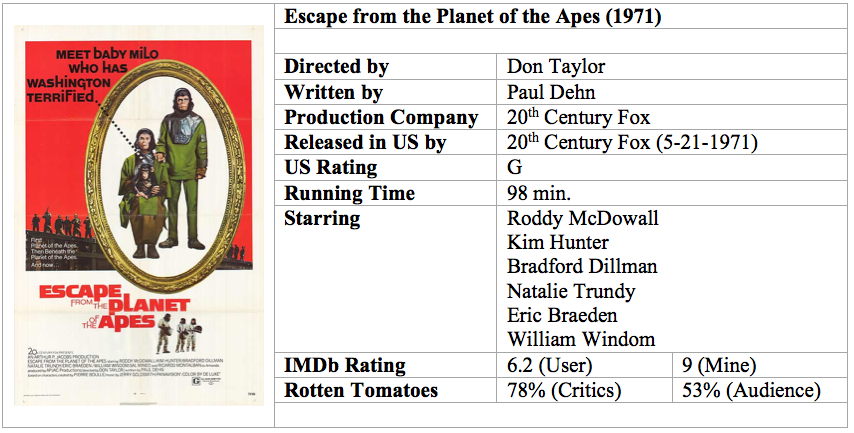
The Abominable Dr. Phibes (1971) & Dr. Phibes Rises Again (1972)

Like Frankenstein Must Be Destroyed, I don’t remember the first time I saw The Abominable Dr. Phibes.  I do, however, remember the commercial for a television airing on CBS.  Over and over again, I watched a clip where a small airplane crashes and a crazed Vincent Price, who watches from the hillside, spins a brass telescope.  It’s not the best of the eight deaths Price orchestrates in the movie, but I guess it safely advertised the movie for all audiences.


In its entirety, The Abominable Dr. Phibes is sublime in its simplicity.  It’s one of those movies that you can summarize in one sentence:  Dr. Anton Phibes (Price) seeks revenge on the nine doctors he considers responsible for his wife’s death.  That’s it.  The structure built on top of this foundation is clever and infinitely entertaining:  Phibes is inspired in his revenge by the Ten Plagues of Egypt from the Old Testament.

In a way, it’s a precursor to movies like Happy Birthday To Me, Final Destination and Saw, where the creative deaths are the stars of the show.  What elaborate murder will Phibes engineer next?  But The Abominable Dr. Phibes has something those movies don’t:  Vincent Price.  Although monstrous and obviously insane, his Phibes is a sympathetic character.  In fact, I think he’s one of the great horror movie villains, played by one of the great horror movie actors.


There’s not much more to say about the plot of The Abominable Dr. Phibes.  Going into too much detail would spoil its pleasures.  Instead, I will just mention that its music, art deco sets and overall style distinguish it from other 1970s horror films.  It’s darkly funny, yet not totally ridiculous.  Perhaps the best way to point out its strengths is to examine the weaknesses of its sequel, Dr. Phibes Rises Again.


Released a year later, Dr. Phibes Rises Again has none of the charms of The Abominable Dr. Phibes.  Where the original was darkly funny, this one is just dark… literally.  Although both movies were directed by Robert Fuest, they have different cinematographers, which I think explains the stark difference in visual appearance.  The art deco sets are mostly gone and the style is not unique in any way, shape or form.

But the largest failing of Dr. Phibes Rises Again is its story.  Yes, there are creative murders, but there is no structure behind them.  Having sought his revenge in the first movie, Phibes now hauls his wife’s body to Egypt where he hopes to resurrect it and find eternal life for both of them.  Simultaneously, Darrus Biederbeck (Robert Quarry) is seeking eternal life, but for reasons that are never clear until the very end of the movie.

Instead of being the one in charge while in pursuit of revenge, he’s simply responding to events that go wrong in his plans for him and his wife.  Had there not been the coincidental journey of Beiderbeck at exactly the same time, Phibes would have gone about his business without disturbing anyone else.  But that wouldn’t be much of a movie, would it?  It’s just too strained a concept and I much prefer watching Phibes/Price be the one taking action, rather than just reacting.


Dr. Phibes Rises Again has none of the fun and joy of The Abominable Dr. Phibes.  Its humor comes from the two Scotland Yard detectives who improbably follow Phibes and Biederbeck to Egypt, then proceed to get lost in the desert.  Inspector Trout (Peter Jeffrey) and Superintendent Waverley (John Cater) are in both movies and in both movies are in pursuit of Phibes.  They’re more over the top here, representing how all subtlety of the first movie is lost in the second.

Another example of the difference in quality comes in the form of Phibes' assistant, Vulnavia.  In The Abominable Dr. Phibes, she is a standout character played by Virginia North.  Here, Vulnavia has beauty, a personality compatible with Phibes and costumes that are lavishly suited to the style of the movie.  In Dr. Phibes Rises Again, she is a plain Jane played by Valli Kemp.  She's pretty enough, I suppose, but has no personality and no style.  It's an additional relationship that is a positive of the original and a negative of the sequel.


Price still has some good dialogue and there are some nice additions to the details of his character, such as the fact that to eat, he sticks a fork in the side of his neck. But the character who fares best in Dr. Phibes Rises Again is that of his wife, Victoria.  Seen only in pictures in The Abominable Dr. Phibes, the lovely (and uncredited) Caroline Munro appears in the sequel in person as her dead body.  All she has to do is lie there and look pretty, at which she succeeds.


The Abominable Dr. Phibes is such a unique movie that it stands on its own as a classic cult masterpiece.  It’s required viewing and should be added to everyone’s home video library.  Dr. Phibes Rises Again is, well, not.  There’s no creative purpose for it to exist except, I’m sure, to make a buck.  Trust me, you are missing nothing by ignoring its existence.  Watching it or owning it is recommended only for hard-core fans and Vincent Price completists.

As a final means to compare the two movies, consider the music during their end credits.  Both use Over the Rainbow; however, in The Abominable Dr. Phibes, it's performed in snappy, Big Band style and in Dr. Phibes Rises Again, it's performed in gloomy, operatic style.  That's a great analogy for the two movies:  the first one is snappy and the second one is gloomy.  Which would you prefer to see?


Tomorrow:  Willard!


Monday, October 6, 2014

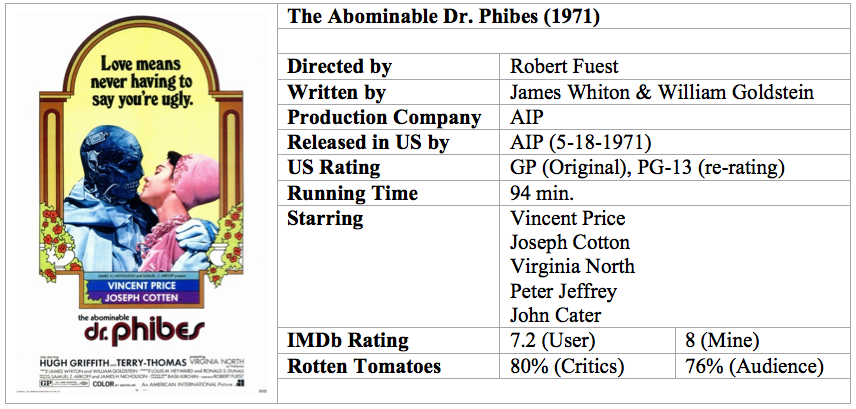
Escape from the Planet of the Apes (1971)

On one of our trips to the Enid Drive-In, likely the Trog/Taste the Blood of Dracula double feature, we saw a trailer for Escape from the Planet of the Apes.  At that point in time, I had never seen a Planet of the Apes movie.  But going home, I distinctly remember hearing my parents discussing how, based on the ending of Beneath the Planet of the Apes, they didn’t think a sequel would be possible.

Beneath the Planet of the Apes
I don’t remember from that point how I became an Apes fanatic, but I know by the time Escape from the Planet of the Apes finally came to town, I was so enthusiastic about seeing it that my parents dropped me off at the Esquire Theater on a Saturday afternoon… by myself.  They had errands to run, I guess, but could no longer put up with my begging to go see it.  I don’t blame them.

As many times as I’ve watched the entire original Apes series since that lonely day in 1971, this one remains my absolute favorite of the five.  Watching it again just the other night to prepare for writing about it, I enjoyed it every bit as much as I ever have, if not more so.

So, yes, when the Earth explodes at the end of a movie, it seems unlikely there would be another one to continue the story.  On the other hand, if there’s anything we know about Hollywood, then or now, it’s that when a movie makes money, there will probably be a sequel.  And the idea for this one is brilliant.

What we didn’t see when the Earth exploded was the three chimpanzees who were able to launch the spaceship of the original astronaut, Taylor (Charlton Heston), who crashed in the first Planet of the Apes movie.  Either due to the explosion or some kind of return trip programmed into the spaceship, Cornelius (Roddy McDowall), Zira (Kim Hunter) and Milo (Sal Mineo) return to “modern day” Earth two years after Taylor disappeared.


One of the many things I love about Escape from the Planet of the Apes is that the events that occur after the “apeonauts” are discovered floating off the coast of southern California make real, logical sense in their progression.  First, they’re taken to a zoo to be studied.  Then, once Zira lets down her guard and speaks out loud, a Presidential commission is formed to investigate from where they came and what the implications are of their presence in 1971.

Then, because the press gets wind of the talking apes and turns them into the latest celebrities, they are treated as guests.  They check-in to the finest hotel and are given a grand tour of the city that includes a huge shopping spree.  Soon, Zira is scheduling speaking engagements at local women’s clubs.  The apes become headline news around the world.


Of course, there is someone who thinks the arrival of the apes signals the end of the world.  (Well, he’s kind of right about that one.)  But he’s not a dastardly villain.  He states his case calmly and collectedly, which opens the door for some truly meaningful debate. Given the power to alter the future, do we have the right to use that power?  Knowing what we do about Hitler now, would we kill him as a baby, or kill his mother if we could travel back in time?

When the President gets involved, it is of course an election year, and he will make no decision that harms them because they are too popular with his electorate.  That is, unless the “bad guy”, Dr. Hasslein (Eric Braeden), can offer him proof of their threat.  That threat may come in the form of Zira’s unborn baby, when everyone learns that she is pregnant.  So the story logically progresses… now the apes are taken to a military base to be interrogated by the CIA.  Couldn’t you imagine events unfolding in a similar fashion if this really happened?


What’s so nice and, well, sweet about Escape from the Planet of the Apes is its innocence.  If it were made today, there would be a more clear-cut villain.  There would be double crosses and backstabbing.  There would be twists and turns as we learned of a betrayal.  Here, everyone means well, and means well for good reasons.

So far, we have a clever story and a realistic screenplay.  Now, add to that characters for whom we really care.  Cornelius and Zira, though a different species, reflect perfectly our human relationships.  True love is seen between the two of them in their marriage, even with their bickering and teasing of each other.  They are perfect in this movie.  Cornelius cautions his wife, “Be yourself, Zira… Your better self.”  And when someone asks if the male ape can speak, he responds, “Only when she lets me.”


And on top of all that, Escape from the Planet of the Apes is very entertaining.  There is a lot of humor as mankind learns more and more about the apes and we learn more and more about their personalities.  There’s great suspense as the apes eventually go on the run.  We are truly invested in them and there’s almost no way the movie can end without shedding a tear.  (Yes, I cry every time I watch Escape from the Planet of the Apes.)

I love time travel stories and this is one is a real head-scratcher.  If Baby Milo is really the catalyst to turn Earth into a planet of apes, it means he had to travel back in time for those events to occur.  But how did they cycle originally start?  What if his parents didn’t escape Earth’s destruction?  Would the cycle have ended and it all really never happened?

The one thing I don’t like about Escape from the Planet of the Apes is Dr. Hasslein’s explanation of time travel.  He compares it to “infinite regression” and gives the example of a painting of a landscape that includes the artist as part of the landscape painting the landscape, etc… infinity.  That doesn’t make any sense to me in the context of these events.  Then again, I’m no Stephen Hawking; I just like to watch movies.


I could go on and one, but one last thing I like about Escape from the Planet of the Apes is that, in essence, it’s the first movie in the series, even though it was the third one released.  But it is in this movie that we first learn how and why man fell and apes rose.  Cornelius recites “prehistory” from ancient scrolls, which would be events that occur in 1971’s future.  It becomes an outline for additional movies and, really, the entire franchise.

Like my ramblings here, all good movies must come to an end.  And the ending of Escape from the Planet of the Apes, like all the other parts of it, is nearly perfect.  I know what happens, so I don’t know how well the twist is telegraphed ahead of time.  But the one thing I remember about seeing it for the first time is that I was truly surprised by it.  I wanted more!  And I got it; two more, in fact.  Conquest of the Planet of the Apes was released a year later in 1972 and Battle for the Planet of the Apes was released a year after that in 1973.


Obviously, I’m recommending this movie.  But my further recommendation, especially if you haven’t seen any of the original Planet of the Apes movies, is to watch them in the chronological order of their stories, not their release.  Watch Escape first, then Conquest.  Skip Battle, it’s the one bad apple in the bunch and doesn’t have much to do with the others.  Then, watch the first Planet of the Apes and Beneath.  I’ve actually never done this, but I bet it adds an interesting perspective to the overall Apes phenomenon.


Tomorrow:  Two-fer Tuesday - The Abominable Dr. Phibes & Dr. Phibes Rises Again!

Sunday, October 5, 2014

Trog (1970)

One of the movies I remember not liking from my adventures at the Enid Drive-In is Trog (1970).  I thought I would sprinkle a few movies like this into my Countdown to Halloween to see if they’ve improved with age.  You can’t say a movie like Trog ever really improves; however, much to my surprise, I liked it more than I would have guessed.

Oh, it’s not good by any means.  But if you get past the cheesiness of the entire thing, it’s somewhat enjoyable.  One of the odd things about this movie is that if it were made 20 years earlier, it would be a lot better in the context of other talky, relatively action-less schlock films with a badly-realized monster.  Maybe that’s a perspective one can see only by looking at it 44 years later.  In 1970, though, it would have seemed just plain bad.

Back then, I thought the monster was horrible.  Today, it’s still hard to get past the silliness of it.  “Trog” is a troglodyte (half man, half ape) discovered by a “freelance expedition” of three explorers in the caves of the English countryside.  There are so many things wrong with the way he looks.  First of all, it’s so obviously a huge mask simply placed on a human body.  His head is rock star hairy, and reaches to waist level, yet his body is hairless.  And he’s stylin’ in a pair of mini-Uggs on legs that sometimes look like are wearing tights.


Even his movements are silly.  Again, he looks just like a man with a huge mask jumping around onscreen.  He’s supposedly deadly; however, it’s hard to take seriously a creature that lifts big fake rocks and throws them at cameramen.  (It’s even harder to take seriously that a cameraman would stand there and let this lumbering creature throw a big fake rock at him.)  There are times when Trog is more threatening, such as when he hangs the village’s butcher on a meat hook.  But those times are mostly out of place with the rest of his shenanigans.

Joan Crawford (yes, I said, “Joan Crawford”) plays Dr. Brockton, a compassionate scientist who wants to domesticate Trog.  Treating him like her pet dog, she beams and says, “Good boy, Trog” when he rolls a ball at her.  It’s unclear what kind of operation she performs that can make him talk, but she seems more interested in bringing him into modern times rather than studying him to learn about our past.  This is even though she claims this missing link can teach us “the baffling mysteries of human evolution”.


Opposing her viewpoint is Sam Murdock (Michael Gough).  His role in the village is unclear, but he’s concerned about Trog ruining his plans for development in the area.  He believes Trog is a monster that should be destroyed.  The two have several verbal battles that scratch the surface of some potentially interesting issues, particularly with the debate in recent years over creation versus evolution.  Even though scripture is quoted on both sides, the conversation never goes deeper than the minimum amount required to generate melodrama.

More shocking to me than the fact that Joan Crawford starred in this Z-movie is the fact that Trog was directed by Freddie Francis, the Academy Award-winning cinematographer who got his start with Hammer Films and Amicus Productions in the late-50s/early 60’s.  With a couple of exceptions, his Hammer and Amicus films are not my favorites, so I guess I shouldn’t be surprised that he doesn’t make more of his effort here.


On the other hand, there is actually a good scare in Trog.  When Murdock stages an escape for Trog, there is a resulting moment that made me jump.  Perhaps if the entire movie took that approach, it would be more effective.  Otherwise, it can barely be considered a horror movie and has no creative or suspenseful work behind the camera.

The screenplay is by Aben Kandel.  When you read his resume, you’ll instantly understand the tone of Trog.  He also wrote, sometimes under pseudonyms, I Was a Teenage Werewolf, I Was a Teenage Frankenstein, How to Make a Monster and Konga.  Trog perfectly fits that sensationalistic, B-movie mold.  Like I said, though, it comes nearly 20 years too late.


Another potentially successful approach for Trog would have been to play it strictly for laughs.  As it is, though, there are only a handful of humorous lines.  For example, as Dr. Brockton feeds Trog, her daughter comments, “For a senior citizen, he has quite an appetite.”  This line is out of place.  It neither releases any tension (because there isn’t any) nor maintains any consistency in tone.  It’s just odd, like the movie itself.

A final oddity in the movie is when, under sedation, Trog remembers various encounters with dinosaurs from his time period, which, by the way is described in a range of either “thousands” to “millions” of years ago.  In these “flashbacks”, we see stock footage from another movie entirely, The Animal World (1956).  This footage, which could have been trimmed, includes some decent stop-motion animation, but also some terrible close-ups that look like they’re from Land of the Lost.

Land of the Lost (1974-1977)
Speaking of that great TV show of the 70s, the cave sets in Trog look like they were shared between the two productions.  The caves themselves look real, but the stalactites and stalagmites are colorfully out of place.  Otherwise, most of the story takes place in the confines of either a laboratory or a courtroom.


Hmmm... have I said one good thing about Trog?  It seems like I have nothing but criticism for it.  Perhaps that’s what makes it tolerable; you know, the “it’s-so-bad-it’s-good” phenomenon.  At the end of the movie, a reporter asks Dr. Brockton if she has anything to say.  She gives a labored glance at Trog’s cave, then pushes the reporter’s camera aside and walks away.  That may best describe the way I feel about Trog.


Tomorrow:  Escape from the Planet of the Apes!

Saturday, October 4, 2014

House of Dark Shadows (1970)

"The Madonnas rest high above.  The lion's head watches the dove.  And in the tomb beneath the hill, the secret flame blows bright and still."


In 1970, a theatrical version of Dark Shadows was released in theaters and was quite profitable for MGM. It was called House of Dark Shadows and remains to this day a creepy, atmospheric and frightening movie. Directed by series creator Dan Curtis, it combines the story of the introduction of Barnabas Collins with the story of his obsession over long-lost love, Josette DuPres.

In order to successfully consolidate what occurred over the course of 154 TV episodes into a 97-minute movie, Curtis and screenwriters Sam Hall and Gordon Russell, also Dark Shadows veterans, had to take some liberties with the story. They did a remarkable job of honoring the original series while at the same time producing a stand-alone movie experience. In essence, they eliminated the character of Victoria Winters (actress Alexandra Moltke had left the series by then) and turned the character Maggie Evans into both the Collins family governess and the possible reincarnation of Josette DuPres.


Since the movie was filmed three years into the TV show, but was telling a story that was two years old, many current cast members got to participate as different characters. Virtually every familiar face from Dark Shadows, the series, appeared in House of Dark Shadows, the movie. And the character of Professor Elliott Stokes (whom I liken to Van Helsing from Dracula), introduced in the series long after the original Barnabas storyline, became a prominent role in the movie.

While the faces are the same, you might at times think the actors behind them are different due to the improvement in their thespian skills. They are actually acting, instead of reading (and forgetting) lines. Also, the sets are positively sturdy when compared to the series. Filmed on location in upstate New York, there’s no fear that they’re going to topple over onto the cast. And they are milked for all their Gothic worth… spider webs, fog, dust, decay and, yes, a lot of dark shadows. Finally, the brief musical cues of composer Robert Cobert, while familiar, are beefed up and extended, providing a marvelous genre soundtrack.


Even if I were not a Dark Shadows fan, I would love House of Dark Shadows. I wholeheartedly recommend it as a classic horror movie of the 70’s. It doesn’t hurt that Barnabas Collins is portrayed almost completely as sadistic and evil, with little of the romantic pining he did later in the series. He’s not really a “reluctant vampire” at all in the movie, which makes him (and it) all the more terrifying.

When House of Dark Shadows was first released, my aunt Nancy took me to see it at the Chief Theater in Enid, Oklahoma. Going after school on a weekday, we arrived late; I realize now it was about 35 minutes into the movie. (After Carolyn’s death-by-vampire, David was playing at the deserted swimming pool on the Collins estate.) 35 minutes later, when Barnabas was transformed into an old man, I told Nancy I wanted to leave. She asked, “To the bathroom?” I replied, “No, I want to leave the movie.”


Once again, as a child, Dark Shadows had terrified me. I have no doubt it was a huge influence on my ever-growing, adult fondness for horror movies. It will always have a spot in my heart, regardless of its incarnation.

For more of my thoughts about Dark Shadows, visit Downright Creepy.


Tomorrow:  Trog!