Saturday, October 11, 2014

Whoever Slew Auntie Roo? (1972)

Nearly ¼ of the movies I watched and loved in the 70s were released by American International Pictures, and 2/3 of those were also produced by AIP.    It's hard now to find how well they did at the box office, but it's safe to say they weren't on any top ten lists during the years they were released.  However, they must have been profitable or there wouldn't have been so many.  One of these is a little gem called Whoever Slew Auntie Roo?


The revelation when I re-watched this movie recently was that it was co-written by "James" Sangster.  Yes, that is "Jimmy" Sangster, famous Hammer Films scribe who wrote classics such as The Curse of Frankenstein and Horror of Dracula.  (His last film for Hammer, Fear in the Night, was released the same year as Whoever Slew Auntie Roo?  He spent most of the rest of his career writing episodes of American television series.)

Whoever Slew Auntie Roo? is not a bad movie, but it comes at the end of the "older women in peril" sub-genre that began in 1962 with What Ever Happened to Baby Jane? so neither is it terribly fresh.  Starring former Hollywood starlets who were perhaps past their prime, these movies (also known as Grande Dame Guignol, hagsploitation, hag horror or psycho-biddy movies) featured characters who were dangerous, insane or mentally unstable women of advanced years.

After Bette Davis and Joan Crawford paved the way in Baby Jane, Crawford starred in Strait-Jacket (1964), Davis and Olivia de Havilland starred in Hush… Hush, Sweet Charlotte (1964), Tallulah Bankhead starred in Die! Die! My Darling (1965), Geraldine Page and Ruth Gordon starred in What Ever Happened to Aunt Alice? (1969) and Shelley Winters and Debbie Reynolds starred in What's the Matter with Helen? (1971).

Here, it's Shelley Winters as Mrs. Forrest and it's not clear through most of the movie whether her role is that of the villain or the victim.  Yes, she's obviously a lunatic, but she never tries to harm anyone.  Ultimately, I suppose she's a victim due to the perception of two children that she is indeed a villain.  In fact, siblings Christopher (Mark Lester) and Katy (Chloe Franks) believe she is a witch and they are living out some type of real life Hansel & Gretel scenario.


All "Auntie Roo" really wants to do is replace her dead daughter with her doppelganger, Katy.  Her good intentions rescue the girl from her dreary life at an orphanage, but I must admit she is a little misguided when she separates her from her brother and keeps her locked in a room upstairs.  Katy doesn’t seem to care much; Auntie Roo gives her everything she wants, which is apparently just an old teddy bear.

I remember one jump scare from when I originally saw Whoever Slew Auntie Roo? at the Chief Theater in Enid, Oklahoma.  It's actually just an abrupt transition that begins with a butcher unexpectedly chopping off a turkey's head.  Yeah, it doesn't make me jump anymore.  But what I didn't remember is that the most shocking scene of the entire movie occurs before the opening credits even roll.

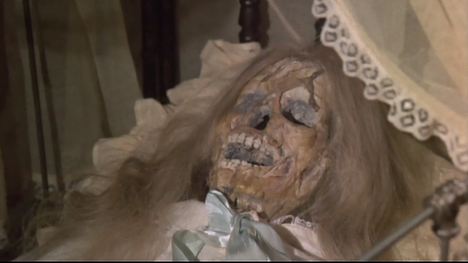
In this scene, the camera slowly pans through a child's room while Winters sings a lullaby.  When the camera stops, we see that she is singing not to her daughter, but to her daughter's corpse.  While her guilt over her daughter's death is the purpose for the entire story, I can't help but believe that this specific scene would make the entire effort more effective if it were placed later in the movie as a twist.

Whoever Slew Auntie Roo? perhaps attempts to be more than it is.  There's a subplot in which the staff is stealing from Mrs. Forrest.  And quite a bit of time is spent setting up a "boy who cried wolf" situation for Christopher.  Neither really goes anywhere, which diminishes the focus of the movie.  The first subplot, though, does provide an unintentionally hilarious scene right out of Scooby-Doo with the kids and the butler, Albie, in a shed.

The score by Kenneth V. Jones is too ambitious for a B-movie and is over the top, even for hagsploitation.  But it accompanies a couple fairly suspenseful scenes.  In one, Winters acts out a sort of reverse "here's Johnny" scene from The Shining.  Instead of trying to chop her way into a room with an axe, though, she's trying to chop her way out.


Critics liked this movie slightly more than audiences on Rotten Tomatoes, with an approval rating of 57% vs. 52%.  I, however, am inexplicably more fond of Whoever Slew Auntie Roo? even though it doesn't carry much weight today.  It's not horrible, but it's evidence that childhood memories add a layer of appreciation to even the worst of movies.


Tomorrow:  Dr. Jekyll & Sister Hyde!

Friday, October 10, 2014

Dracula vs. Frankenstein (1971)

Sometimes memory does not fail me, but I wish it would.  Just because I clearly remember how bad a movie was when I first saw it, I usually like to hope that I'm remembering incorrectly.  Or, at the very least, I like to hope that the movie improves over time or in retrospect fits my critical sensibilities.  Such is not the case with Dracula vs. Frankenstein (1971), a movie so boring when I saw it at the Enid Drive-In at the age of 8 or nine years old that I ran around playing hide and seek during it.  I'm also pretty sure I told my parents we could leave early.  (Either that, or they drove me out of there early, although I'm sure I didn't complain.)

I’d also like to think there would be at least one redeeming element in almost any movie, but in this one, there's not.  I thought it might lie among the appearances of three horror legends: J. Carrol Naish, Lon Chaney Jr. and/or Forrest J. Ackerman.  Ackerman (founding editor of Famous Monsters of Filmland) fares best as Dr. Beaumont, but he's mercifully knocked off in a brief scene midway through the movie.  Naish (whom I remember as the hunchback, Daniel, in House of Frankenstein) is merely present as Dr. Frankenstein (aka Dr. Duryea).  And poor, poor Chaney (The original Wolf Man) is just plain sad to watch as Frankenstein's henchman, Groton.

Check out THIS mustache!
This was Naish's last film; he died two years later at the age of 77.  I don't mean to be cruel, but in Dracula vs. Frankenstein, he's confined to a wheelchair, as I assume he was in real life.  It certainly appears that he has no energy to stand on his own.  Dentures clacking, he compares his "creature emporium" at the local amusement park to historical Roman spectacles.  Eyes periodically darting to the side, presumably to read his cue cards, he babbles on and on about reality being the grandest illusion of all and human blood being the very essence from which new illusions are created.  He's always shot in close-up, as if he's not even occupying space in the same room as the other actors.


This was also Chaney's last film; he also died two years later at the age of 67.  His is a sad story.  Overshadowed by his father, he was plagued with illness and alcoholism.  In Dracula vs. Frankenstein, he's fat and clearly unhealthy.  Blessedly, he plays a mute, so if you close your eyes, you can pretend he's not even there.  As Groton, Frankenstein gives him inexplicable injections that actually make him more crazed.  After these injections, he takes his axe out chopping for new female experiment victims.  In between, he's a trembling simpleton who cuddles with puppies in the one clever part I'll admit about the movie: it's reminiscent of his earlier, classic performance as Lennie in Of Mice & Men.


If the stars look awful, the monsters look worse.  Dracula (Zandor Vorkov) sports an afro and goatee and seems to have issues with perspiration.  No one could look further from the image of the traditional vampire king.  And for some reason, he speaks as if he's standing in a well, with a tinny, echoing voice.  But as Frankenstein's original monster, John Bloom is even worse yet.  His face is a swollen blob of pasty flesh with no distinguishing features.  In Frankenstein movies, the creature's forehead is normally built-up with prosthetics and make-up, but here, it's everything below the cheekbones that's exaggerated.  He looks like he's holding a large rectangular box in his mouth.


What about the story itself?  Well, there's no improvement for the movie in that area.  It's not clear what Dracula hopes to get out of the deal when he appears to Frankenstein to tell him there are ways they can help each other.  He provides the monster's body, but to what end?  Near the movie’s conclusion, he states that Frankenstein’s serum will help him become immortal, but isn’t Dracula already immortal?  When he talks about a comet returning to complete the monster’s life cycle, I stopped paying attention.  You’d think it’s all a set-up for the titular battle between monster titans.  I suppose it is, but it’s so poorly staged it’s just not worth it.

For multiple reasons, Dracula vs. Frankenstein is physically distasteful to me.  While at first glance it's the very definition of a grade-Z drive-in movie, it's really not even that good.  I made Super 8 films in my backyard when I was a kid that are of better quality than this.  It's dark, has horridly-dated porn music (even for 1971), is obviously dubbed (badly) in places, includes misplaced fade-outs and abrupt cuts… need I continue?  It is simply the longest, most excruciating 90-minute movie I've ever seen.  Oh, and I didn't even mention it includes a Las Vegas song and dance number (at the world's most pathetic nightclub) and a ridiculous love song on the soundtrack as the young protagonists walk the beach.


THIS is a movie I'd enjoy watching!
Who is responsible for this mess?  Well, that would be a man named Al Adamson, founder of Independent-International Pictures which produced and distributed many of the movies he wrote and directed.  I want to say that Adamson went to the Ed Wood school of filmmaking, but there's none of the giddy joy in Dracula vs. Frankenstein that you experience when watching one of Wood's movies.  Sadly, Adamson's life ended with a story far more compelling than his movies (if this one is any indication).  In 1995, he went missing and was found five weeks later buried beneath the floor of his newly remodeled bathroom.  That’s a movie I’d like to see.


Tomorrow:  Whoever Slew Auntie Roo?

Thursday, October 9, 2014

Frogs (1972)

One of the prevalent horror subgenres in the 1970s was the “Nature Gone Wild” or “Eco-Horror” film.  Until I recently researched the topic, I always assumed this subgenre sprung from the blockbuster success of Jaws.  However, Jaws was not released until 1975, and prior to it there were at least half a dozen movies about various members of the animal kingdom going crazy and attacking humans.  More so than Jaws, I’d say the phenomenon was a result from Alfred Hitchcock’s The Birds, which was released in 1963.

Between the time panicked birds were picking at Tippi Hedren’s wig and rogue Great White sharks were taking bites out of Robert Shaw, humans on screen were victims to rats (Willard), rabbits (Night of the Lepus), snakes (Sssssss), ants (Phase IV) and cockroaches (Bug).  One of the earliest “Nature Gone Wild” films happens to also be one of my favorite childhood horror movies:  Frogs, from 1972.  I’d like to imagine that it was actually the inspiration for the birth of the subgenre.  In fact, it may have been ahead of its time with its combination of deadly creatures.

Yeah, frogs themselves aren’t so deadly, even if they’re piling up and rubbing their slimy digits on your glass porch windows.  So they’re just the title villains in a movie where snakes, spiders, lizards, alligators and even butterflies take their revenge against a rich family that abuses the local ecology.  It sounds almost comical, but Frogs is played straight, and offers some surprisingly effective scenes.  I was likely first exposed to Frogs when it was the cover story for Famous Monsters of Filmland #91.  Take a look.  How could you not love this movie?!?


It’s the 4th of July at the Crockett estate in rural Florida.  Jason Crockett (Ray Milland) is a bitter old man confined to a wheelchair.  It doesn’t matter why, other than the fact that because of his handicap, he insists his entire clan get together once a year to go through the motions of being a normal, functional family.  It is so important to Jason, in fact, that when confronted with the question, “What if nature were trying to get back at us,” he’d rather die in his chair than be late for dinner or cancel the annual croquet match.

The family members are numerous, but the intimacies of their relationships are merely suggested.  They’re mostly on hand simply to be killed.  Frogs would be absolutely sublime if there was more of a story in regards to the family.  Jason is an old, rich man who’s going to die, whether at this 4th of July party or soon after.  Why not have the children and grandchildren backstab each other for his inheritance?  Family drama against the backdrop of nature knocking them off one by one could actually make an interesting statement about whom the real monsters are.


Frogs has no such aspirations.  It is simply another assembly line production from American International Pictures (AIP).  But that’s not necessarily a bad thing.  If any of the aforementioned creatures of the swamp make you shiver, then you’re naturally going to be anxious when they appear on screen.  It stands to reason, then, that any competent director could manipulate the footage even slightly to send you over the edge.  I think veteran TV director George McCowan does it here.  OK, so maybe lizards aren’t scary.  But when they knock over bottles of poison, they can be.

In Frogs, Sam Elliott plays Pickett Smith, an environmentally conscious photographer who gets stranded at Jason’s party.  Like any other plot point in the movie, there’s a hint of romance between him and Joan Van Ark, who plays Karen Crockett, Jason’s granddaughter (I think).  I don’t want to be inappropriate here, but I have to point out that with the tight jeans of the 1970s, there’s a different kind of snake featured in this movie.  Just take a close look at Elliott’s crotch area in this scene from Frogs.  I don’t know if Van Ark is afraid of snakes, but she should be of this one:


The killings in Frogs aren’t nearly as creative as the circumstances that get people in positions to be killed.  These aren’t super-frogs (or snakes, spiders, lizards, alligators and butterflies).  But if you think about it, death by any of these creatures would be pretty gruesome.  As for the frogs themselves, the sound of them croaking all day and night would be enough to drive me crazy.  The movie soundtrack seems completely filled with the noise and every scene seems to be intercut with an image of them hopping closer to the house.


The make-up in Frogs is pretty good, especially the decaying body of the first victim that is discovered face down in the swamp.  And the music by Les Baxter is appropriately schlocky, particularly the abrupt stinger during the penultimate shocker.  I particularly like the ending.  Using creative close-ups, camera angles and sound, it’s effective without being silly.  I mean, it could really happen as shown.  In a movie like Frogs, you keep waiting for them to do some damage.  But sometimes simply hopping on top of an already dead body is damage enough.


Tomorrow:  Dracula vs. Frankenstein!

Wednesday, October 8, 2014

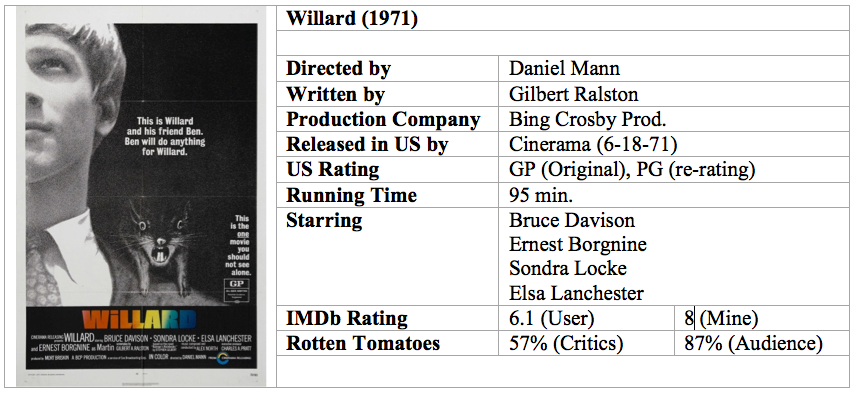
Willard (1971)

We learn everything we need to know about Willard Stiles (Bruce Davison) in the opening scenes of the movie Willard.  He forgets papers at work, misses his bus and is smothered at home. His mother’s friends tell him he’s an extrovert, “but it’s all inside”, and verbally harass him about being tougher.  Yeah, he’s a real loser.  However, he’s a sympathetic loser.  Each time the man is knocked down, suspense builds toward the inevitable moment when he will fight back.

In 2014, the method for his revenge may not seem terribly original, but when Willard was first released in 1971, it was quite unsettling.  In the back yard that he is supposed to clean up for his sick mother (Elsa Lanchester), he befriends two rats, Ben and Socrates.  He trains them and their growing number of friends and family until his cellar is virtually teaming with the creatures.  Feeding them, taking them to work, he ultimately has them under his control.


He first uses them for a little harmless fun:  ruining an anniversary party for his truly horrible boss, Al Martin (Ernest Borgnine).  He then uses them as a distraction so he can steal the money he needs to pay back taxes.  And finally, he uses them for murder.  As we all know, though, deeds like this don’t usually go unpunished.  When Willard realizes the errors of his ways, he tries to get out, but his new friends don’t want it to be that easy.

For a mostly straightforward story like this, Willard is surprisingly effective, even by today’s standards.  I’ll admit it’s a little lighthearted at first, but once the last straw is placed on the camel’s back, the movie takes a sinister turn and is scary as heck.  The penultimate scene where Willard confronts Martin in his office is chilling.  Martin opens the door to find Willard standing there with a multitude of rats swarming over and around his feet.


There’s something inherently creepy in a movie about rats.  Just seeing a rat makes me squirm.  And to hear the tiny footsteps of hundreds of them marching along a wooden floor makes me lift my feet onto my chair.  But to have my worst fears about them realized… that they might attack me… well, it’s almost too much to bear.  All that aside, though, the movie contributes its own creepiness with a disciplined use of camera angles, close-ups and nightmare-like lighting.

Director Daniel Mann (Butterfield 8, Our Man Flint) maximizes the thrills with what appears on screen to be a very low budget.  But he proves you don’t need a lot of money to make an effective movie.  The screenply is by television veteran Gilbert Ralston; you name a 60’s TV series and he likely wrote an episode of it, including Star Trek (Who Mourns for Adonais?)  It’s based on the novel, “Ratman’s Notebooks,” by Stephen Gilbert.  I’d love to read the book sometime.


Besides the chilling scenes are a couple filled with dark humor.  When Willard’s mother dies and her friends bring food to the house, they swarm around the dinner table, eating like a bunch of hungry rats.  Willard stands back and watches.  Never before disgusted with his friends that are literally rats, he looks like he’s going to be physically sick watching these people stuff their faces (while at the same time, by the way, ignoring him.

It’s also an intentionally humorous moment when a potential romance at the office, played by Sondra Locke what was only her third screen role, gives Willard a gift:  a cat.  After dropping her off, she tells him to take care of it.  He replies, “I’ll take care of her all right.”  Don’t worry; this is during the early, innocent part of the movie.  He doesn’t feed it to the rats.  Instead, he asks a man in a phone booth to hold it for a moment, then quickly drives away.


Willard is more dated than most of the 70s horror movies I’ve been watching this month, and I don’t mean in a scene where a shocked secretary exclaims, “Can you imagine having $8,000 to spend on a vacation.”  (Wait a minute; I’m not sure I can imagine that.  That’s still a lot of money in 2014.)  I’m talking about a scene after Martin’s anniversary party erupts in chaos.  Mocking one of his employees, he says, “You should have seen this ‘hero,’ up on a chair screaming like a fag.”

Near the end of the movie, Willard channels Norman Bates and talks to a framed photo of his mother.  “Martin killed Socrates just like he killed my father.  It doesn’t matter; I make the decisions now.”  So it’s really all about power and control.  Willard doesn’t have it.  Then he thinks he does.  But it isn’t too long before he has to unconvincingly say to his rats, “Each time I come down here there are more of you.  Stop it.  I am the boss here.”  The lesson is brewing…


Willard must have been successful at the box office (and I don’t imagine it had to make much more to be profitable), because there was a Willard-less sequel called Ben.  You’re probably more familiar with its theme song by a young artist named Michael Jackson than you are with the movie.  Just think about this the next time you hear the sweet melody:  he’s singing about a rat.  (I’ve been unable to locate a copy of Ben to review.)

Willard remains important today if for no other reason than because of its cast.  Sondra Locke later became Mrs. Clint Eastwood.  Elsa Lanchester was the original Bride of Frankenstein.  Ernest Borgnine was an Academy Award winner.  And you’ve seen the great character actor Bruce Davison in any number of the 207 films in which he’s appeared.  But you’ve never seen the skinny, awkward and, yes, mousy Bruce Davison until you’ve seen him in Willard.


Tomorrow:  Dracula vs. Frankenstein!