Monday, October 5, 2015

The Invisible Man (1933)

For this year's Countdown to Halloween, it's all-Universal Monsters, all-the-time, from Dracula (1931) to The Creature Walks Among Us (1956).  Join me daily for a fresh perspective on movies you may not have watched in a long time, if ever.  Today, a character with whom I sometimes relate... The Invisible Man!


Although I often feel like other people don’t see me, particularly when I’m driving, I wonder what it would feel like to be truly invisible.  I’d use the power mostly to infiltrate conversations so that I could witness what someone really talks about when I’m not present.  While I would probably play a few harmless pranks, I don’t think I’d do anything malicious.


When he literally becomes transparent in the 1933 Universal classic, The Invisible Man, Jack Griffin (Claude Rains) sets his sights on something more grand: ruling the world.  The problem is, the formula he invented is also driving him crazy, so he mostly succeeds only at wreaking havoc in the village where he’s hiding and has set up an impromptu laboratory.

Griffin is a different kind of “mad scientist” than Henry Frankenstein.  They both suffer variations of a God Complex, but while Frankenstein wants to create life, Griffin remains grounded in the here and now.  Plus, Frankenstein lives to regret his actions; Griffin does not.  He has literally been driven mad and there is no hope for him, certainly not with the additional pressure of being the victim of a manhunt.

Nearly an hour into the movie, Griffin finally does some real damage, derailing a train and robbing a bank, but, hey, he gives the money away on the street outside.  With constant maniacal laughter, I never felt Griffin was a terribly dangerous guy in The Invisible Man.  I was more scared of him in the quiet moments, such as when he exacts is revenge on the colleague who betrayed him.


That would be Dr. Arthur Kemp (William Harrigan), whom Griffin blackmails to assist him and soon becomes nearly as unhinged as Griffin.  He tells Kemp that it was just a scientific experiment at first, to do something no one ever had, but  “Suddenly I realized the power I held.”  Then, “I must have a partner, Kemp, a visible partner to help me with the little things.”

“We’ll begin with a reign of terror, a few murders here and there.”  This is why I have trouble with taking Griffin seriously: his “reign of terror” consists mostly of running through the village stealing hats.  And his malice becomes petty; he becomes more enraged when he learns that the constable thinks he’s a hoax.  Rather than simply enacting a plan, he’s reacting to demonstrate how dangerous he is.

Rains is very good in the role of Jack Griffin, especially considering his face is either wrapped in bandages or invisible until the very end of the movie.  He compensates with gestures and movements that perfectly convey the stature of a madman.  I just think he goes a little far with the laughter.  Perhaps it’s exaggerated during the scenes where we can’t see him, just so we can track where he is.


The Invisible Man shares another theme with Frankenstein, although more overt.  There’s a love triangle among Griffin, Kemp and Flora Cranley (Gloria Stuart).  Kemp is more outspoken about his desire for Cranley to be with him than Victor Moritz was with Elizabeth; however, the women always seem to like the bad boys better.  She sticks up for Griffin to his very end, naively thinking he can be redeemed.


The special effects remain amazing considering this is a 1933 production.  They’re at their best when Griffin is unwrapping his bandages to reveal nothing is there (“he’s all eaten away”), but suffer a little from some unfortunate “outlining” when clothing is moving around the room.  Objects move a little too steadily, also, but when you let your imagination take it from there, the power of The Invisible Man is limitless.

Tomorrow: The Bride of Frankenstein!

Sunday, October 4, 2015

The Mummy (1932)

For this year's Countdown to Halloween, it's all-Universal Monsters, all-the-time, from Dracula (1931) to The Creature Walks Among Us (1956).  Join me daily for a fresh perspective on movies you may not have watched in a long time, if ever.  Today, a monster whose popularity escapes me... The Mummy!


Of all the wonderful elements in Universal’s The Mummy (1932), there’s one that’s largely absent: a mummy.  The cloth-wrapped version of (Boris) Karloff “The Uncanny,” with makeup by the great Jack Pierce (Frankenstein), is not seen again after the first 12 minutes of the movie.  We don’t even see him walk; we see only a lingering strip of cloth as he exits the tomb from which he was resurrected by the recital of an ancient curse.

This is great for the mystery and imagination, but how and where did we get the iconic mage of a mummy shuffling along, one arm outstretched or perhaps both arms carrying a beautiful woman into a swamp?  It must have been from a subsequent mummy movie, of which there are many (at least five more from Universal itself.)  Fortunately, we still have Karloff for the entire movie, as well as fantastically moody direction by Karl Freund.


A year earlier, Freund was the Cinematographer on Dracula.  In what is in essence a remake of Dracula, Freund calls the shots behind the camera and the result is a consistently more atmospheric and moody production.  He loves that strip of light across his creatures’ eyes; used so effectively in Dracula, he repeats the technique here.  It makes Karloff’s unwrapped character 10 years later in the story, Ardath Bey, even more sinister than Bela Lugosi.


Bey is really Imhotep, an Egyptian priest who was buried alive for trying to resurrect the woman he loved, princess Ankh-es-en-amon.  In modern Cairo, he encounters Helen Grosvenor (Zita Johann), who is the reincarnation of his princess.  He plots to kill her, mummify her, and then resurrect her so that she can be his eternal bride.  (“I was buried alive.  I ask of you only a moment of agony.”)  Sound familiar?  That’s often where the comparison to Dracula is made.


Having forgotten that The Mummy was largely mummy-less until I re-watched it recently, I now am a little more forgiving of Universal’s 1999 version, an action-packed epic masquerading as a horror film.  In retrospect, it does a pretty good job of harvesting the core elements from its predecessor.  I won’t say one of the elements in The Mummy (1932) is action; however, it is quite suspenseful and relies more heavily on supernatural forces instead of a particular monster itself.


I’m a little perplexed by the enduring popularity of the mummy as one of the evergreen monsters, along with Dracula, Frankenstein’s monster, the Wolf Man and/or the Creature from the Black Lagoon. What does a mummy actually do?  Sure, it’s a frightening image, and the dead brought back to life is usually scary.  But with the insane popularity of faster moving, hard to kill zombies, you’d think a creature that’s movements are restricted and can easily turn to dust would be rather ho-hum.

But I digress.  The Mummy (1932), regardless of the monster, is a worthy addition to the roster of Universal Monsters, within the context of their 1930’s origins.  It’s the first movie that’s mystery unfolds during the time it was made; Dracula and Frankenstein took place in the past.  It also gained huge momentum from the public’s fascination with mummies, as demonstrated following the discovery of Tutankhamun’s (King Tut’s) tomb in 1922.

Tomorrow: The Invisible Man!

Saturday, October 3, 2015

Frankenstein (1931)

For this year's Countdown to Halloween, it's all-Universal Monsters, all-the-time, from Dracula (1931) to The Creature Walks Among Us (1956).  Join me daily for a fresh perspective on movies you may not have watched in a long time, if ever.  Today, perhaps my favorite... Frankenstein!


Until I re-watched it recently, I would have told you that the "monster" in Frankenstein was simply misunderstood, a mere victim of circumstance.  However, I'm now reconsidering that assessment and am willing to argue that the creature stitched together from dead bodies and brought to life by science was, in the absolute sense of the word, a true monster.  In fact, as an older and wiser man, there are several things about Universal's 1931 horror classic that I never consciously realized until now.

First of all, in making my case that Henry Frankenstein's experiment was a true monster, let me remind you that it was installed with a criminal (abnormal) brain when hunchback assistant Fritz dropped the glass bottle containing the normal brain.  It's hard to imagine the corrupt neural pathways of an abnormal brain were corrected when transplanted into a new head.  Likewise, it's hard to imagine that a criminal mind brought back to life would suddenly have turned over a new leaf.


Next, we've always assumed that Fritz was a cruel sadist when taunting the monster with fire.  However, we don't really know why he does that.  Perhaps there's a reason.  Is there a scene we didn't see where the monster purposely terrified Fritz?  Maybe he's scared of it instead of trying to demonstrate superiority over it.  Yes, Fritz seems to be the aggressor in the scene we do see, but remember, he's simple.  He's the one responsible for the abnormal brain in the first place.


So what about the scene where the monster throws little Maria into the lake after running out of flower petals?  Surely that was a result of innocent confusion.  Except, what if it wasn't?  If you're with me so far, it's not a stretch to say his action was purposeful and he murdered the child.  This doesn't change the motivation of the angry, torch-bearing mob; however, it definitely changes our entire set of feelings toward what ultimately happens to the monster.  He's no longer a victim; instead, he's a villain.


Finally, we don't know from what kind of criminal the monster's brain was harvested.  Listen to its growl when, on her wedding night, Elizabeth turns to find it lurking behind her.  She screams and it growls, not angrily, but lasciviously.  Why did it come after Henry's bride, anyway?  If it were a confused, innocent creature, wouldn't it have run as far as it could from its creator?  It's almost like it knew that threatening Elizabeth would hurt Henry more than physically harming him.


Frankenstein was made in the early 1930s.  I'm certain the filmmakers did not intend for the monster to be a child molester or sexual predator.  Based on these points, though, I get a little vibe of that.  What complicates all this is that, even if the monster is pure evil, the performance by Boris Karloff is sympathetic.  If my theory is true, we feel sorry for him regardless.  We could spin it all a positive way and say the movie demonstrates how we have the capacity to forgive people who do terrible things.

There's also a story the movie doesn't tell about a possible Henry-Elizabeth-Victor Moritz triangle.  Early in the movie when Victor and Elizabeth discuss the absence of Henry, he's opaquely hostile toward Henry, more than what is suggested by his comment that Henry's manner was "very strange" when he saw him three weeks ago.  Later, when Dr. Waldman, Victor and Elizabeth visit Henry in his laboratory, Henry is visibly hostile toward Victor, focusing all his anger directly on him.


While this dynamic suggests Elizabeth may have had a "thing" for Victor before or during her relationship with Henry, Baron Frankenstein places the blame for any romantic complications to his son.  He believes Henry's absence on the eve of his wedding is due to another woman.  Henry isn't too fond of his father, either, stating that he "never believes in anyone."  That relationship carries through from Henry as a father to his "son," the creature with which he is also disappointed.


Again, I'm not saying that any of these ideas purposefully come from the intentions of the filmmakers; I'm saying that they crossed my mind when watching Frankenstein for the first time in many years.  Also, I'm not looking at the character based on subsequent Universal sequels; I'm simply commenting within the context of one movie.  Bride of Frankenstein is historically considered the more subversive movie, but perhaps James Whale, the director of both, infused a little subtext into the original as well.

Tomorrow: The Mummy!

Friday, October 2, 2015

Dracula (Spanish Version)

For this year's Countdown to Halloween, it's all-Universal Monsters, all-the-time, from Dracula (1931) to The Creature Walks Among Us (1956).  Join me daily for a fresh perspective on movies you may not have watched in a long time, if ever.  Today, a curiosity... the Spanish version of Dracula!


At the same time Dracula was filming during the day, a Spanish version was filming at night using the same sets.  With the addition of some adaptation of the script by B. Fernandez Cue, this Dracula (1931) actually improves upon some of the American version’s flaws.  However, due to Lugosi’s absence in the title role, the movie is ultimately not as good.  In fact, the sometimes-comical performance of Carlos Villar as Conde Dracula detracts from any mood that may be simmering.

The Spanish Dracula begins much the same as the American Dracula; however, director George Melford uses more blatant devices to create atmosphere: smoke comes out of his coffins and doors take an awfully long time loudly creaking open.  On the other hand, when Renfield (Pablo Alavrez Rubio) first encounters Dracula, he’s merely standing on the stairs in the castle instead of eerily descending down them.  But this Dracula is more crazed than scary.


One improvement to the plot is that, once in London, Dracula heads straight to the theater.  There is no scene of him attacking a woman on the street.  This scene seems out of place in the American version.  In the theater, we actually see a ballet being performed on stage; in the American version, we only hear it.  It’s odd the little setting choices that are different, such as this scene and the one where Van Helsing (Eduardo Arozamena) examines a woman’s body in a small room instead of a large hospital theater.

If you think it’s Lugosi’s Dracula who envelops victims in his cape, you’re wrong.  His attacks are cut short by editing while Villar’s are perhaps extended a little bit.  And we see actual bite marks in the Spanish version that we never see in the American version.  Overall, the movie is not as polished; however, it occasionally surprises with a little detail, such as Renfield stopping in the middle of a rant to catch a fly.  The American version could have benefitted from such a moment.


Speaking of Renfield, he’s much more Joker-crazy here than Dwight Frye was in the other Dracula.  Intermittent scenes between him and Van Helsing in the other Dracula play more as interrogations in the Spanish version, which both makes sense to the story and makes it drag a little less.  In fact, the total running time is nearly 30 minutes longer and doesn’t really feel like it. 

The Spanish Dracula follows the script of the American Dracula pretty closely, even though some scenes occur in a different order.  However, near the end, it takes some distinct turns of its own.  The same scenes in a different order extend the final attack on Eva (Lupita Tovar) and add a bit of excitement as orderly Martin shoots at a bat.  Dracula carries Eva down his Carfax Abbey stairs and tosses Renfield over the edge instead of down them.


The climax adds the factor of the rising sun that is absent from the American version.  There’s also an explanation for why Eva isn’t in her coffin that is never provided for Mina in the American version.  As Juan Harker (Barry Norton) and Eva go up the steps, Van Helsing stakes his vampire.  There’s no pithy speech to end the movie; it closes based on its own merit.


Truth be told, neither version of Dracula is perfect.  If Tod Browning had directed something closer to the actual script used for the Spanish version and made similar editing choices, it would come a lot closer.  But it would have to star Lugosi.  I’m a superficial guy; the look of the American version wins out for me over the story in this case.  On the other hand, there’s a reason we still hear about the Spanish Dracula when we don’t hear about the Spanish Frankenstein, if it even exists.

Tomorrow: Frankenstein!

Thursday, October 1, 2015

Dracula (1931)

For this year's Countdown to Halloween, it's all-Universal Monsters, all-the-time, from Dracula (1931) to The Creature Walks Among Us (1956).  Join me daily for a fresh perspective on movies you may not have watched in a long time, if ever.  Today, the one that started it all... Dracula!


With so many screen versions of Dracula produced during the last 84 years, it’s sometimes easy to overlook Universal’s 1931 original.  Everyone has a favorite Dracula, whether it is Christopher Lee, Frank Langella, Jack Palance, or one of a host of others.  However, every so often we should pay tribute to the original, Bela Lugosi.  I daresay without his performance in the title role, few others would have followed.

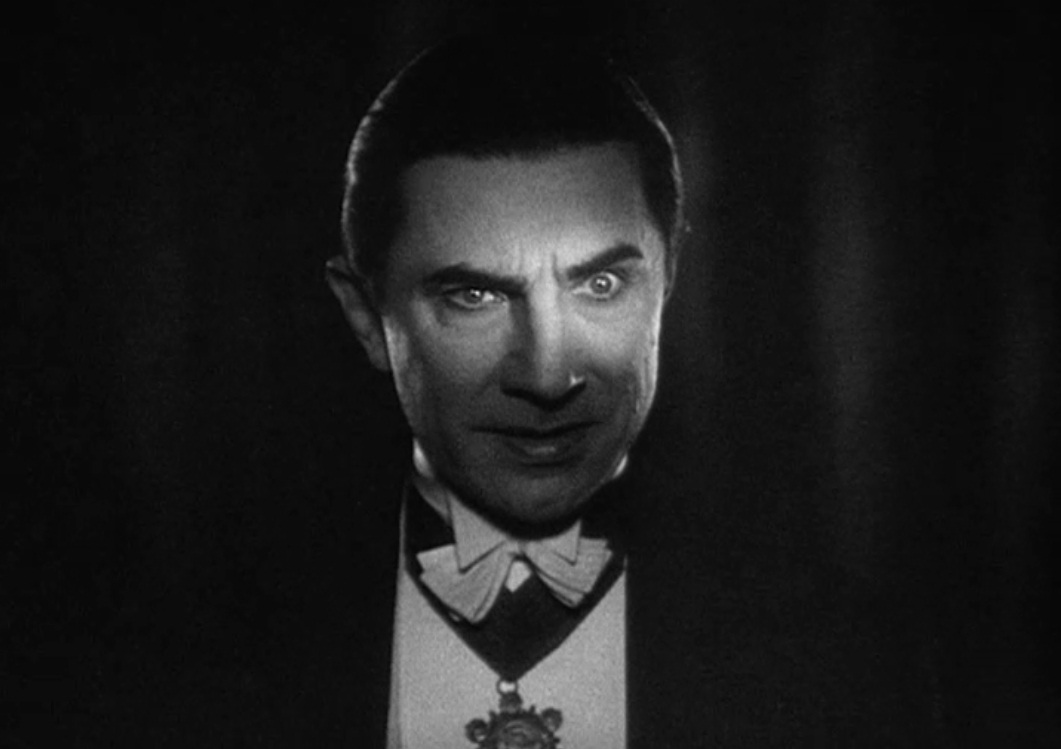
We see Lugosi first rise from his coffin five minutes into the movie.  Age has been kind to the atmosphere of Dracula.  Any loss of film quality only adds to the foggy, dreamlike quality of the scene.  As his bony fingers slowly emerge from the coffin, various rats and insects likewise crawl in and out of other confined areas of the castle’s vast basement chamber.  While we witness one of his three “brides” actually sit up in her coffin, we only see Dracula standing by his while the camera moves closer to his mesmerizing eyes.


His reputation precedes him.  En route to the castle, Renfield (Dwight Frye) hears from the Transylvanian townspeople rumors that Dracula and his wives take the form of wolves and bats and leave their coffins at night.  The stories don’t deter him, though; he’s there to deliver a lease on Carfax Abbey.  After a mysterious, driverless carriage ride to the castle, Renfield enters a cavernous foyer where his host slowly descends from the stairs and bids him welcome.

Renfield’s time at Castle Dracula is not long, though, and ends with a visit from a bat and the three zombie-like brides.  We next see him “aboard the Vesta,” a ship “bound for England.”  He’s now become a raving madman, opening Dracula’s coffin and telling his master when the sun has gone down.  This scene, familiar in many other versions of the story, unfolds here with little mystery, even though the ship arrives in London and is found with everyone dead and its captain tied to the wheel.

In London, Lugosi’s Dracula is the only lit man walking down the street.  On his way to the theater, he stops for a “cocktail” from a woman selling flowers.  Once arrived, he introduces himself to Doctor Seward (Herbert Bunston), the man caring for the now institutionalized Renfield, his daughter, Mina (Helen Chandler), her friend, Lucy (Frances Dade) and Mina’s beau, John Harker (David Manners).  I’m not sure why Dracula is drawn to them, unless the connection is Renfield.

Lucy finds Dracula “fascinating,” but Mina wants someone more normal.  If by “normal” she means bland, that certainly what she has with Harker.  He’s largely ineffective as a hero.  Then again, that role is usually reserved, as it is here, for Professor Van Helsing (Edward Van Sloan).  After Dracula quickly disposes of Lucy during a nighttime visit, Van Helsing examines “another dead” body with the same two marks and concludes that “we are dealing with the undead.”


Here, the 74-minute movie begins to drag and this version’s origins as a stage play become apparent.  Van Helsing knows that Dracula is living at Carfax Abbey, but instead of going to dispose of him right away, a couple of days pass talking about him.  I guess that’s so Dracula has time to sink his fangs into Mina.  It’s not clear why he targets her and extends her transition instead of killing her right away like he does his other victims.

If there are weaknesses in the screenplay by Hamilton Deane & John L. Balderston, adapted from the play by Garrett Fort, director Tod Browning does his best to lessen them with cobwebs and Gothic mood.  And the plot holes are often filled by a number of classic lines, including:

“I never drink… wine.”
“Listen to them.  Children of the night.  What music they make.”
“To die, to be really dead, that must be glorious!”

It all leads to Van Helsing and Harker following Dracula and Mina to Dracula’s crypt at Carfax Abbey.  I like the creative touch of Van Helsing tearing apart a coffin lid to make a stake, although you would have thought he’d come prepared.  As you would expect from a 1931 movie, we don’t see Dracula’s demise; instead, we only hear it as Harker searches for Mina.  She screams, he finds her and she’s OK.  “There’s nothing to fear.  Dracula is dead forever.”  Well, at least until the next version.


It had been a long time since I’d seen Dracula and I recognized nuances to Lugosi’s portrayal that I had either forgotten or never realized were there.  He moves very slowly and deliberately, appropriate for one of the undead, I suppose.  While we never see him step out of his coffin, a couple of times we see him curling up from the waist beside it.  When he bends over to bite Lucy, I could swear he smells her first.  There are times that he truly looks like he’s in pain and suffering.


And those eyes… My favorite effect in the movie is the lighting used to highlight his eyes.  Call it glowing or pulsating, the simple strip of light across his face accentuates that feature.  If eyes really are windows to the soul, then Lugosi’s eyes lead to a dark place that remains scary even today.  Dracula may have no soul, but Lugosi’s performance does.  While the movie may be flawed, Lugosi is flawless.  You cannot overstate what he did for Dracula, for Universal Pictures, and for the horror genre altogether.

Tomorrow: Dracula (Spanish Version)!